As part of efforts to strengthen technical capacity in water resources and environmental management within the Cuvelai and Kunene River Basins, the UNDP-GEF CUVKUN Project successfully conducted a four-day virtual short course on Water Resources Planning and Modelling from 21 to 24 September 2026. The training brought together 72 participants, including 52 men and 20 women, representing a diverse range of institutions and sectors across Angola.
The training was organised under the “Enhanced Water Security and Community Resilience in the Adjacent Cuvelai and Kunene Transboundary River Basins” (CUVKUN) project, a USD 11.17 million initiative funded by the Global Environment Facility (GEF) and implemented by the United Nations Development Programme (UNDP) and executed by the Global Water Partnership Southern Africa (GWPSA), in collaboration with the Cuvelai Watercourse Commission (CUVECOM), the Kunene Permanent Joint Technical Committee (PJTC), and the Governments of Angola and Namibia.
The course was facilitated by Eng. Agnelo Miguel and Eng. Garcia Kanica, who guided participants through a comprehensive programme covering key concepts and practical applications in water resources planning and management.
Throughout the four-day programme, participants explored a range of technical topics, including Water resources planning and development, Integrated Water Resources Management (IWRM), Hydrological systems and hydrological modelling, Data management and analytical tools, Geographic Information Systems (GIS) and remote sensing, artificial intelligence and machine learning applications in water management, management solutions, digital technologies and artificial intelligence.
The course attracted participants from a broad spectrum of institutions, including water-sector agencies, municipal administrations, the Provincial Infrastructure Office, technical services, non-governmental organisations, educational institutions, factories and other stakeholders involved in water resources management. This diversity encouraged knowledge exchange and strengthened collaboration among institutions working towards sustainable water governance.
Addressing Key Challenges in Water Resources Management
During the discussions, participants highlighted several important challenges affecting water resources planning and management. These included the need for reliable and accessible hydrological data, improved use of modelling tools, effective management of uncertainty, integration of multiple data sources and enhanced institutional capacity to use digital and analytical technologies.
The training provided a valuable platform for stakeholders to discuss these challenges and explore innovative solutions that can support evidence-based planning and decision-making.
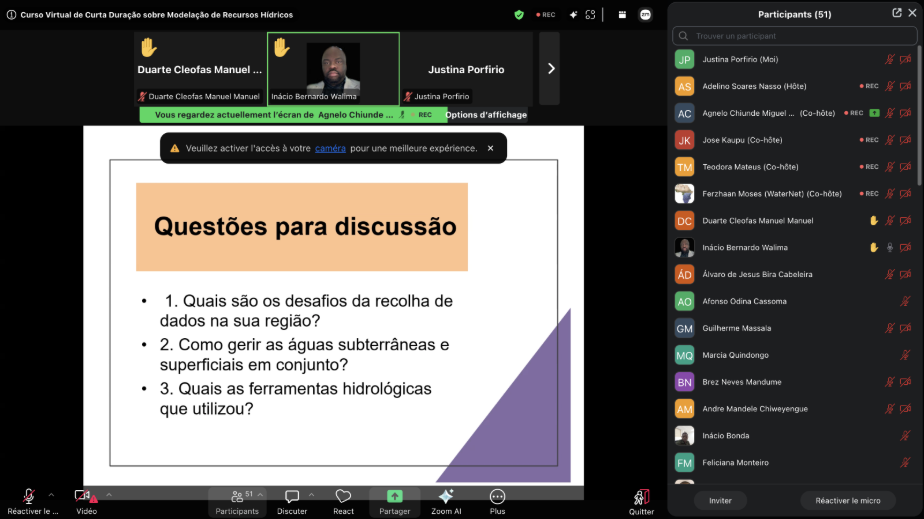
Photo – CUVKUN Water Resources Modelling Virtual Training
Post-training evaluation showed that all six modules recorded significant knowledge gains, with the largest improvements in the modules on disaster recovery, technology, and response management, precisely the areas where participants had reported the least prior knowledge. Of the participants who completed the evaluation, 67% rated the training “Excellent” and the remainder rated it “Good,” while all respondents said they were able to apply at least some of what they had learned in their work. Facilitator engagement received a perfect score.
“The training was very informative and relevant to our work. However, I would appreciate further training on data analysis, as this is an area where I still need to strengthen my skills. In future sessions, it would also be beneficial to include site visits and field observations, as these would help participants better connect the theoretical concepts with practical implementation,” said Bresneves Mandume, Technician at GABHIC.
What’s Next
Following the successful completion of the training, participants are encouraged to apply the knowledge and tools acquired within their respective institutions and professional activities. Training materials will remain available for future reference, while additional opportunities for capacity development in hydrological modelling, GIS, data management, artificial intelligence and decision-support systems will be explored through future project activities.
Through such trainings, the CUVKUN Project continues to support Angola’s efforts to improve water resources management and build resilience to environmental and water-related challenges in the Cuvelai and Kunene River Basins.